
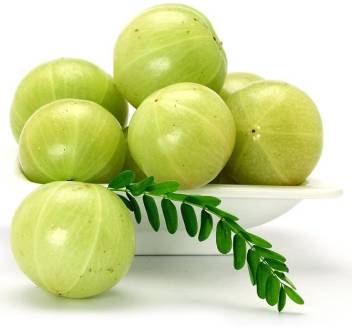
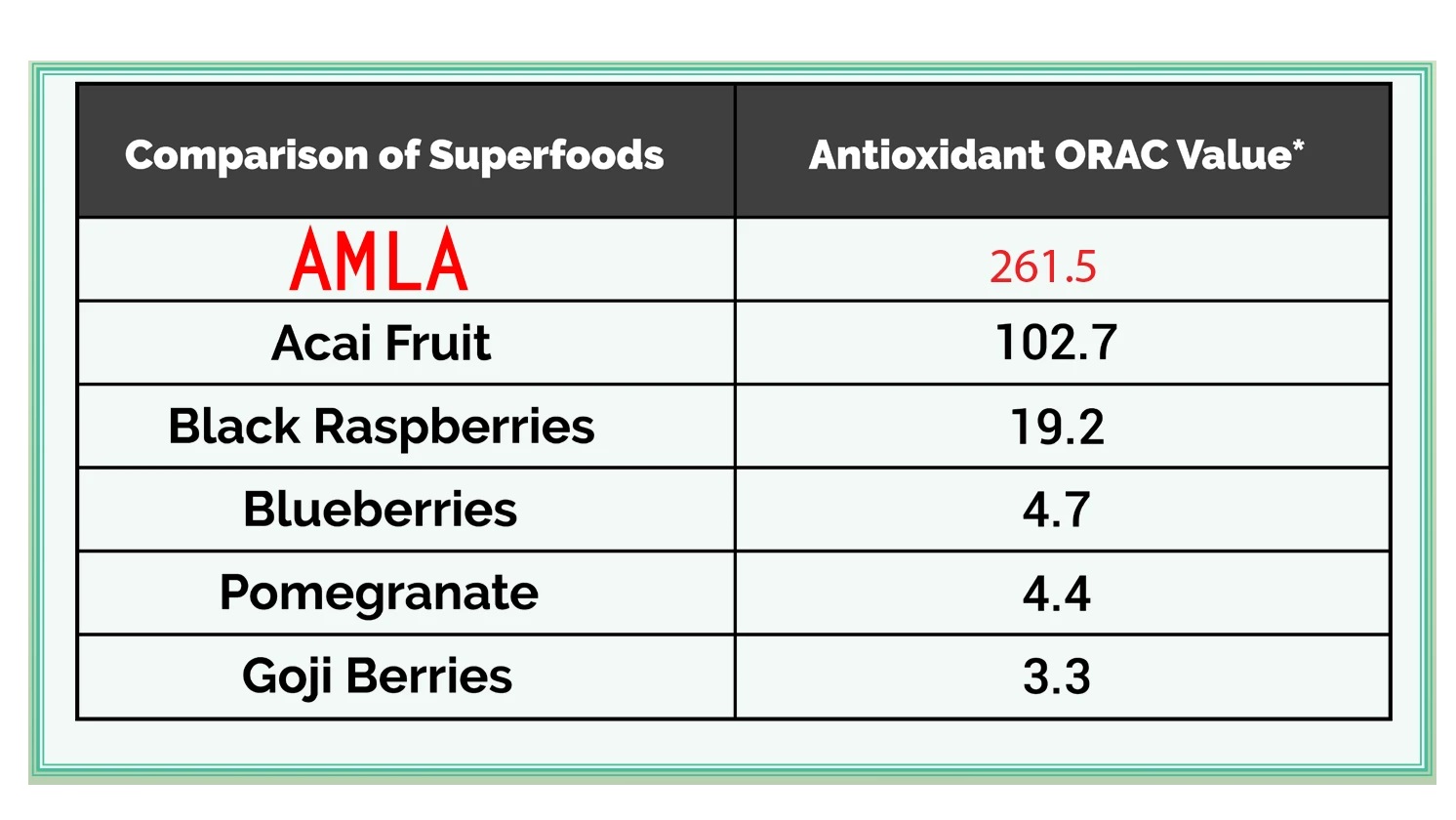
Amla, also known as Indian gooseberry, is extremely high in antioxidants. In fact, it has the highest antioxidant levels of any so-called superfood. As with all antioxidants, amla has been shown to reduce oxidative stress, thus inhibiting the production of cell-damaging free radicals.
Beyond its super-antioxidant status, amla is being studied for use in cancer prevention, treating inflammation, and in relation to diabetes and cardiovascular health.
Studies related to cancer prevention have suggested that amla possesses radiomodulatory, chemomodulatory, chemopreventive effects, free radical scavenging, antioxidant, anti-inflammatory, antimutagenic and immunomodulatory activities, all of which may be beneficial in cancer prevention.
Meanwhile, as further research is ongoing in relation to diabetes and cardiovascular health, amla has been shown to improve blood vessel function and has demonstrated a significant effect on lowering lipids.
Cautions and warnings
- If you are pregnant or breastfeeding, consult a health care practitioner prior to use.
- If you have or develop abdominal pain, nausea, fever or vomiting, consult a health care practitioner.
Known adverse reaction
A laxative effect may occur with amla, in which case discontinue use.
AVAILABLE RESEARCH
Antioxidant
In this study, researchers procured food samples from countries worldwide and assayed the samples for their total antioxidant content using a modified version of the FRAP assay. The results found that in a sample of 13 berries, “amla was found to have an especially high antioxidant capacity.”
-Carlsen MH, Halvorsen BL, Holte K, Bøhn SK, Dragland S, Sampson L, Willey C, Senoo H, Umezono Y, Sanada C, Barikmo I, Berhe N, Willett WC, Phillips KM, Jacobs DR Jr, Blomhoff R. The total antioxidant content of more than 3100 foods, beverages, spices, herbs and supplements used worldwide. Nutr J. 2010 Jan 22;9:3.
This study investigated the chemistry and antioxidant properties of four commercial embilica officinalis fruit extracts in order to determine if there are any qualitative-quantitative differences. The research found that “extracts demonstrated varying degrees of antioxidative efficacy.”
-Poltanov EA, Shikov AN, Dorman HJD, Pozharitskaya ON, Makarov VG, Tikhonov VP, Hiltunen R. Chemical and Antioxidant Evaluation of Indian Gooseberry (Emblica officinalis Gaertn., syn. Phyllanthus emblica L.) Supplements. Phytotherapy Research 2009;23: 1309–1315.
The aim of this study was to determine whether supplementation with amla extract could reduce oxidative stress in patients with uremia. The data concludes that “amla supplementation may increase plasma antioxidant power and decrease oxidative stress in uremic patients.”
-Chen TS, Liou SY, Chang YL. Supplementation of Emblica officinalis (Amla) extract reduces oxidative stress in uremic patients. American Journal of Clinical Medicine 2009;37(1): 19–25
The hepatoprotective activity was studied by observing the effect of herbal extracts (including amla) on t-BH induced reduction in cell viability of HepG2 cells. In addition, the reducing power of the extracts and their ability to scavenge free radicals were evaluated using two antioxidant assay systems. The results found that “these extracts have potential hepatoprotective activity which is mainly attributed to the antioxidant potential, which might occur by reduction of lipid peroxidation and cellular damage.”
-Hiraganahalli BD, Chinampudur VC, Dethe S, Mundkinajeddu D, Pandre MK, Balachandran J, Agarwal A. Hepatoprotective and antioxidant activity of standardized herbal extracts. Pharmacognosy Magazine 2012;8(30): 116–123.
This review identifies the plants with antioxidant activity in Ayurveda medicine. A formulation of some rasayanas with well-defined antioxidant properties has been examined, which includes amla.
-Scartezzini P, Speroni E. Review on some plants of Indian traditional medicine with antioxidant activity. Journal of Ethnopharmacology 2000;71: 23–42.
ADDITIONAL RESEARCH
There is ongoing research on the effects of amla as it relates to the following health concerns:
Cancer Prevention
Amla is reported to possess radiomodulatory, chemomodulatory, chemopreventive effects, free radical scavenging, antioxidant, anti-inflammatory, antimutagenic and immunomodulatory activities. These properties may be beneficial in cancer prevention.
- Baliga, et al. Amla (Emblica Officinalis Gaertn), a Wonder Berry in the Treatment and Prevention of Cancer. European Journal of Cancer Prevention: 20.3 (2011): 225–39.
This animal study suggested that alma exhibits anticancer activity against selected cancer cells. Further study is warranted to determine whether it has anti-invasive and cancer preventing properties.
- Ngamkitidechakul, C., Jaijoy, K., Hansakul, P., Soonthornchareonnon, N. and Sireeratawong, S. (2010), Antitumour effects of phyllanthus emblica L.: Induction of cancer cell apoptosis and Inhibition of in vivo tumour promotion and in vitro invasion of human cancer cells. Phytother. Res., 24: 1405–1413.
Diabetes and Cardiovascular Effects
This study shows that “P. emblica (amla) significantly improved blood vessel function in type 2 diabetics, possibly via the reduction of biomarkers of oxidative stress and systemic inflammation.”
- Usharani, P., Fatima, N., & Muralidhar, N. (2013). Effects of Phyllanthus emblica extract on endothelial dysfunction and biomarkers of oxidative stress in patients with type 2 diabetes mellitus: a randomized, double-blind, controlled study. Diabetes, Metabolic Syndrome and Obesity: Targets and Therapy, 6, 275–284.
This study demonstrated a significant effect on lowering lipids in patients taking alma powder.
- Muhammad Shoaib Akhtar, et al. Effect of Amla Fruit (Emblica Officinalis Gaertn.) on Blood Glucose and Lipid Profile of Normal Subjects and Type 2 Diabetic Patients. International Journal Of Food Sciences And Nutrition 62.6 (2011): 609–16.
This study demonstrated that men who took alma had a significant reduction in cholesterol levels, however, their cholesterol increased when they stopped supplementing with it.
- Jacob A, Pandey M, Kapoor S, and Saroja R. Effect of the Indian Gooseberry (amla) on Serum Cholesterol Levels in Men Aged 35-55 Years. Eur J Clin Nutr 42.11 (1988): 939–44.
Inflammation
The phenols in alma may decrease acute inflammation. The mechanism of this action is likely due to the effect of phenols on quenching free radicals.
-Middha, S. K., Goyal, A. K., Lokesh, P., Yardi, V., Mojamdar, L., Keni, D. S., … Usha, T. (2015). Toxicological Evaluation of Emblica officinalis Fruit Extract and its Anti-inflammatory and Free Radical Scavenging Properties. Pharmacognosy Magazine, 11(Suppl 3), S427–S433
AVAILABLE RESEARCH ON CONTRAINDICATIONS
Laxative effect may occur, in which case, discontinue use.
This study was aimed to provide pharmacological basis for the medicinal use of phyllanthus emblica fruit in indigestion and constipation using the in-vivo and in-vitro assays. The research concludes that the phyllanthus emblica possesses prokinetic and laxative activities, thus provides a rationale for the medicinal use of phyllanthus emblica fruits in indigestion and constipation.
- Mehmood, M. H., Rehman, A., Rehman, N.-u. and Gilani, A.-H. (2013), Studies on Prokinetic, Laxative and Spasmodic Activities of Phyllanthus emblica in Experimental Animals. Phytother. Res., 27: 1054–1060.
If you have or develop abdominal pain, nausea, fever or vomiting, consult a health care practitioner.
This document provides accurate data to guide consumers in safe utilization of herbal products. It includes information that describes the effects of amla in circumstances that may cause abdominal pain, nausea, fever or vomiting.
- McGuffin M, Hobbs C, Upton R, Goldberg A, editors. 1997. American Herbal Products Association's Botanical Safety Handbook. Boca Raton (FL): CRC Press.