
Agatha M. Thrash, M.D.
Preventive Medicine
We should point out that B-12 deficiency is a very rare disorder, and the overwhelming majority of cases occur in non-Vegetarians.
It has been believed that only animal products contain sufficient quantities of vitamin B12 to meet human needs. This is not the case, and many pure vegetarians live a lifetime without evidence of B12 deficiency. We believe that if it is searched for the cause of B12 deficiency can always be found in some other quarter than the absence of animal products in the diet. Some of these matters will be briefly presented.
Until the last few years, dietary deficiency of B-12 had never been considered as a cause of cellular deficiency. Malabsorption increased need or increased elimination have been accepted as the most likely causes of a cellular deficiency of B12. Known causes of B-12 malabsorption are a lack of intrinsic factor and hydrochloric acid in the stomach, the removal or disease of the second portion of the ileum, and competition for B-12 by microorganisms or intestinal parasites.
The small intestine of healthy humans can contain bacteria that are capable of producing vitamin B12. There are at least two groups of germs normally in the small bowel, Pseudomonas and Klebsiella. These may synthesize significant amounts of the vitamin, high enough in the intestinal tract to be absorbed in the terminal ileum (Nature 283:781; February 21, 1980). Both these germs can overgrow and cause an unhealthy small bowel.
[ Another review found that 40 percent of patients in the U.S. had unexplained low vitamin B12 levels. Researchers attributed this shortfall to “food cobalamin malabsorption,” meaning the vitamin B12 that is naturally present in foods is simply not absorbed. Luckily, research has shown that these people are still able to absorb the crystalline form found in supplements and B12-fortified foods.
The absorption process for vitamin B12 is actually quite complex, requiring several physiologic elements to take place for it to occur adequately, and many factors can contribute to deficiencies. For example, long-term use of antacids, H. pylori infection (causes stomach inflammation (gastritis), peptic ulcer disease, and certain types of stomach cancer.), alcohol abuse, smoking, atrophic gastritis, and conditions that slow the movement of food through the gastrointestinal tract (such as diabetes, scleroderma, strictures, diverticula), are all associated with vitamin B12 deficiencies.] ForksOverKnives B12 Questions Answered
[ Vitamin B12 deficiency can develop for the following reasons:
Absence of intrinsic factor also called — Intrinsic factor is a protein secreted by cells of the stomach lining. The intrinsic factor attaches to vitamin B12 and takes it to the intestines to be absorbed. An absence of intrinsic factor is the most common cause of pernicious anemia. Absent intrinsic factor is often associated with a condition called atrophic gastritis, a thinning of the lining of the stomach. Atrophic gastritis is more common in elderly people of African-American or Northern-European descent. In these people, pernicious anemia develops at about age 60.
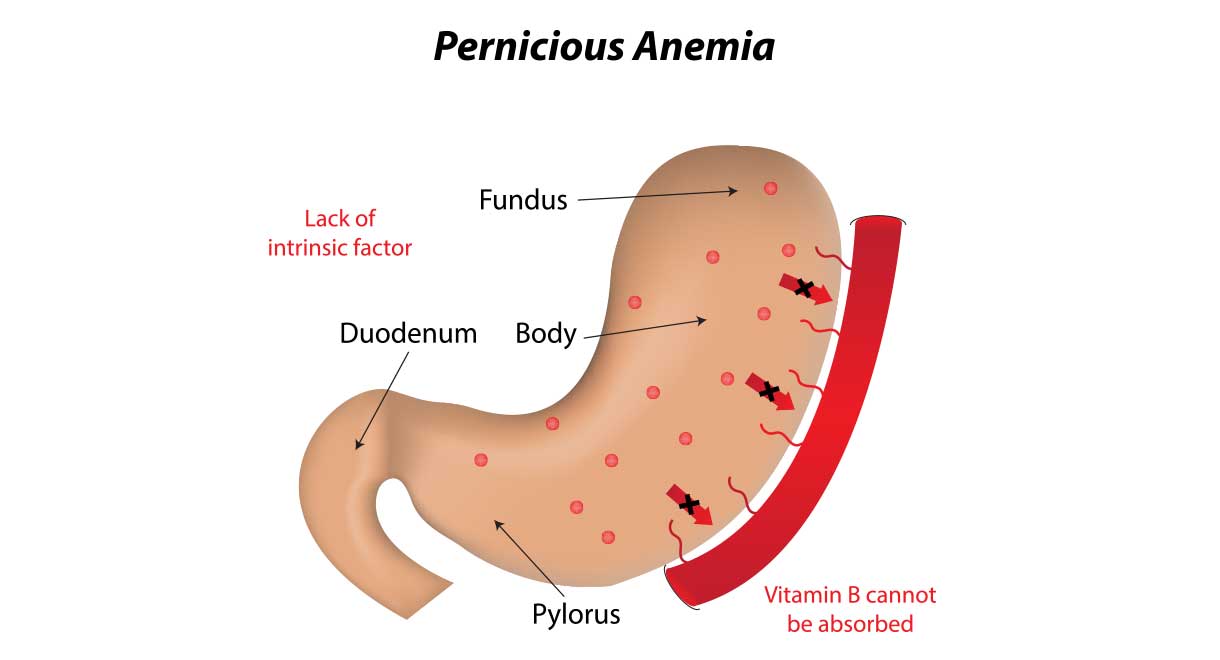
In children, decreased levels of intrinsic factor can be an inherited (genetic) condition. When this happens, low levels of intrinsic factor produce symptoms of juvenile pernicious anemia in patients younger than age 10.
Pernicious anemia occurs more commonly in people who already have diseases that are linked to immune-system abnormalities, such as Graves' disease, hypothyroidism (under-functioning thyroid gland), thyroiditis (inflammation of the thyroid), vitiligo and Addison's disease (adrenocortical insufficiency).
Removal or destruction of the stomach — Vitamin B12 deficiency can develop in people who have had surgery to remove part or all of the stomach.
Overgrowth of bacteria — Some people develop vitamin B12 deficiency as a result of conditions that slow the movement of food through the intestines (diabetes, scleroderma, strictures, diverticula), allowing intestinal bacteria to multiply and overgrow in the upper part of the small intestine. These bacteria steal B12 for their own use, rather than allowing it to be absorbed by the body.
Dietary deficiency — Vegans (strict vegetarians who do not eat any meat, fish, egg or dairy products) can develop vitamin B12 deficiency because they lack vitamin B12 in their diets. In patients with bulimia or anorexia nervosa, vitamin B12 deficiency also can be related to diet. However, your liver can store vitamin B12 for up to five years, so it's rare for a diet to cause this anemia.] Harvard B12 Deficiency causes
Around 3,000 men and women aged 26-83 investigated as a part of the Framingham offspring study showed a surprising 39 percent of the participants to have blood levels of B12 below 350, the level at which neurological signs of vitamin B12 deficiency or high homocysteine levels sometimes occur. Younger people were just as likely to have low levels as older people. Those who got their B12 from supplements or fortified breakfast cereals or dairy products were less likely to be deficient than those who got their B12 from dairy products, meat, poultry, or fish. It was suggested by the researchers that the proteins in meat may make B12 less available. The RDA for B12 is from 6-25 micrograms, depending on the age, the higher levels being in older people (American Journal of Clinical Nutrition 71:51, 2000).
Factors that Affect B12 Needs
1. Meat, other animal products, and refined carbohydrates (sugars), when used generously, may more than double the amount of B12 you must have from all your sources to stay healthy.
2. Persons who use drugs, chemicals, or beverages that destroy B12 (tobacco, alcohol, caffeine, etc.), will require more B12 to stay healthy.
3. Megadoses of vitamin C may produce B12 deficiency by destroying the cobalamins during the time both B12 and vitamin C are in the intestinal tract together. More than 500 milligrams of vitamin C can destroy 50-95 percent of B12 in the intestinal tract. If both vitamin C and B12 must be taken for some condition, B12 should be taken at the beginning or before the meal, and vitamin C should be taken after meals.
4. Oral contraceptives increase the need for vitamin B12.
5. Cooked eggs decrease B12 absorption.
6. Intestinal parasites, especially tapeworms, and explosively growing bacteria in the intestinal tract such as from infected or inflamed intestines, can effectively compete with the host for B12 and make the requirements higher. Helicobacter pylori infection can cause malabsorption of vitamin B12.
7. Almost 90 percent of older people with serum B12 levels less than 150 show evidence of tissue vitamin B12 deficiency. Older people are more subject to disability from low B12 than younger individuals (Journal of the American Geriatric Society 44:1355;1996). We can see wisdom for persons over age 60 with low B12 levels taking a supplement. About 100 micrograms daily chewed for two minutes before swallowing (to get the “salivary factor”) will probably be enough to supply the system with all its needs.
Dangers of Supplement Overdose
Generally, the routine use of vitamin B-12 supplements is not advised. In animal studies, there have been cases of increased cancer production in animals receiving high levels of B-12. It has been noted that the animals have increased the production of white blood cells such as occurs in chronic myelogenous leukemia. A case has been reported overdosage in the treatment of pernicious anemia. A group of French investigators reported a series of cases suggesting that B-12 may stimulate the multiplication of cancer cells and aggravate the disease. Certainly, there is experimental evidence that B-12 encourages cell division and certain tumor cells in particular.
Patients with rheumatoid arthritis present serum B-12 levels significantly higher than normal subjects. It is known to be higher in patients with ulcerative colitis, leukemia and other serious illness. A high serum B-12 level should be a signal for a thorough medical evaluation.
For more information contact:
Uchee Pines Lifestyle Center
30 Uchee Pines Road #75
Seale, Alabama 36875
Tel. 334-855-4764
www.ucheepines.org
For more detailed information, please read Nutrition for Vegetarians by Agatha Moody Thrash, M.D. and Calvin L.Thrash, Jr., M.D. p. 66-70